- New
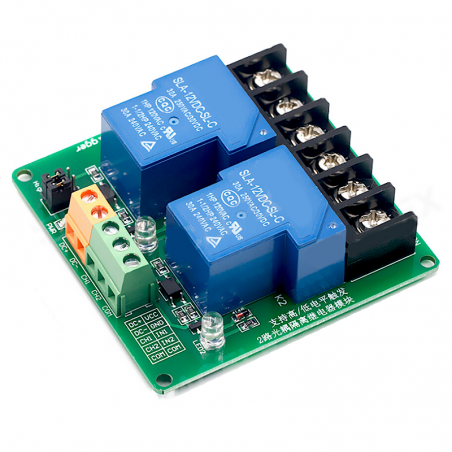

2-channel relay module powered by 5 V DC, featuring high-power 30 A relays, optocoupler isolation and selectable HIGH/LOW-level triggering. Each channel can independently control an AC or DC load, making the module suitable for microcontrollers, PLCs, automation systems and electronic projects.
There is also a 1-channel version of this module available at this link!
If you have any questions on this product please feel free to contact us.
*Disclaimer: The images are merely illustrative.
The 5V 30A 2-Channel Relay Module is designed to provide independent control of two electrical loads using low-voltage control signals.
The module incorporates two high-power electromechanical relays, each with a 5 V DC coil and SPDT (Single Pole Double Throw) contacts. Each relay provides COM (Common), NO (Normally Open) and NC (Normally Closed) contacts, allowing loads to be switched on or off depending on the required circuit configuration.
The relays are based on the SLA-05VDC-SL-C type, specified for contact currents of up to 30 A and maximum switching voltage of 250 V AC. For DC applications, this relay/module family is specified for switching up to 30 A at 30 V DC.
Each channel has its own control circuit, allowing the two relay outputs to operate independently. The module uses optocoupler isolation between the control section and the relay drive circuit, providing electrical separation between the control signal and relay circuitry.
The trigger mode can be selected using the onboard jumper, allowing the module to operate with either HIGH-level or LOW-level triggering.
The module operates from a 5 V DC supply and provides screw terminals for convenient connection of the power supply, control signals and switched loads.
Four mounting points are provided for direct installation in an enclosure, panel or custom project. This version is supplied without a DIN rail mounting bracket.
| Specification | Value |
| Type | Electromechanical relay module |
| Number of channels | 2 |
| Supply voltage | 5 V DC |
| Relay | SLA-05VDC-SL-C |
| Contact type | SPDT / 1 Form C |
| Contacts per channel | COM / NO / NC |
| Maximum contact current | 30 A per channel |
| Maximum AC switching voltage | 250 V AC |
| Maximum DC switching voltage | 30 V DC |
| Isolation | Optocoupler |
| Trigger | Selectable HIGH / LOW |
| Indicator | Relay status LED |
| Connection | Screw terminals |
| Channels | Independent |
| Mounting | Mounting holes |
| DIN rail | No |
| Relay coil | 5 V DC |
| Coil type | Non-latching |
| Coil resistance | approx. 27 Ω |
| Coil rated power | approx. 0.9 W |
| Relay operate time | approx. 10–15 ms |
| Relay release time | approx. 10 ms |
The SLA-05VDC-SL-C relay specifications are supported by component datasheets and distributor technical data.
The first relay is independently controlled and provides:
The second relay operates independently and provides:
This configuration allows two separate loads to be controlled independently.
COM – Common
Common relay contact.
NO – Normally Open
The contact is open while the relay is inactive. When the relay is activated, COM is connected to NO.
NC – Normally Closed
The contact is connected to COM while the relay is inactive. When the relay is activated, this connection is interrupted.
The trigger mode can be selected using the onboard jumper.
LOW-level trigger
The relay channel is activated by a LOW logic level.
HIGH-level trigger
The relay channel is activated by a HIGH logic level.
HIGH/LOW trigger selection is a documented feature of this 30 A optocoupler-isolated relay module family.
The module uses optocoupler isolation in the control circuit.
An optocoupler transfers the control signal optically, reducing the direct electrical connection between the control input and relay drive circuitry.
This architecture is useful when additional separation between the control electronics and the switched relay circuit is required.
Suitable for:
The 30 A relay rating makes this module suitable for applications requiring greater switching capacity than typical 5 V relay modules equipped with 10 A relays.
The module can be integrated with:
The control interface should always be checked against the output voltage and logic characteristics of the control system.
A microcontroller can control Channel 1 to switch a lighting circuit through COM1/NO1.
At the same time, Channel 2 can independently control a second load, such as a motor.
For example:
Channel 1 → Lighting
Channel 2 → Motor
Both loads can therefore be controlled independently from the same relay module.
The 30 A / 250 V AC and 30 A / 30 V DC ratings represent the maximum specified contact ratings of the relay. They should not be interpreted as a guarantee that every type of load can continuously operate at these values under all conditions.
The actual permissible load depends on:
Inductive loads such as motors, pumps and solenoid valves can generate significantly higher inrush currents than their nominal operating current.

Related products
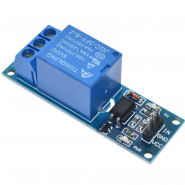
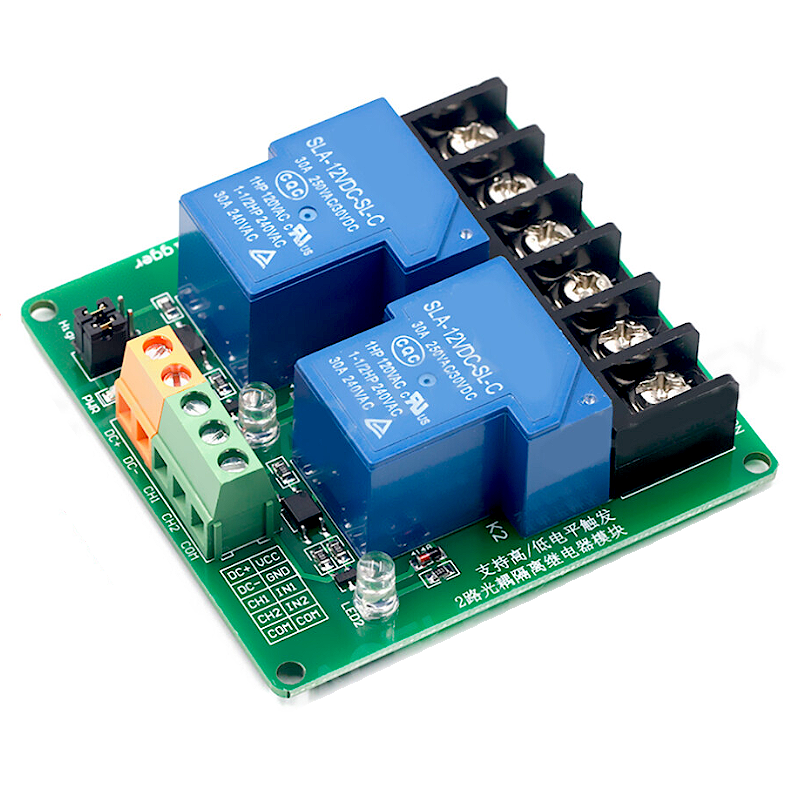
2-channel relay module powered by 5 V DC, featuring high-power 30 A relays, optocoupler isolation and selectable HIGH/LOW-level triggering. Each channel can independently control an AC or DC load, making the module suitable for microcontrollers, PLCs, automation systems and electronic projects.
There is also a 1-channel version of this module available at this link!